
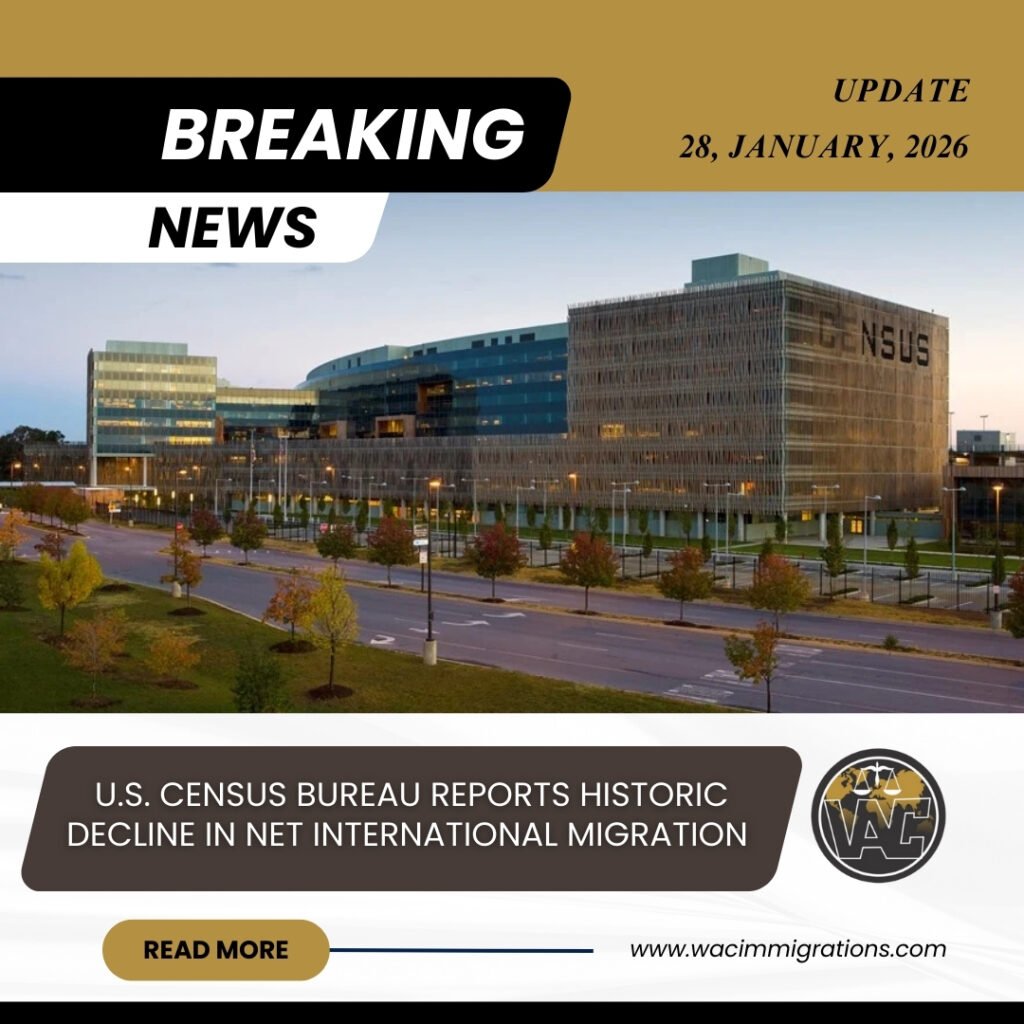
The U.S. Census Bureau has released new population estimates showing a major and historic decline in Net International Migration (NIM). International migration is one of the most important factors shaping population growth in the United States, and the latest figures highlight a significant shift in recent trends.
📉 Key Findings: Sharp Drop in Migration Numbers
According to the Census Bureau’s Vintage 2025 estimates:
- Net international migration peaked at 2.7 million in 2024
- Declined to 1.3 million in 2025
- Is projected to fall further to around 321,000 in 2026, if current trends continue
This represents one of the most dramatic migration declines seen in decades.
🌍What is Net International Migration (NIM)?
Net International Migration refers to the “net” gain or loss in the U.S. population due to people moving across borders.
It is calculated as:
Immigrants moving into the U.S.
➖People emigrating out of the U.S.
= Net International Migration
A positive number means more people are arriving than leaving.
🔍Why is Net Migration Declining?
The Census Bureau explains that the large drop from 2024 to 2026 is due to two main reasons:
- Decrease in Immigration
Fewer people are entering the United States compared to previous years.
- Increase in Emigration
More people are leaving the U.S., which has contributed significantly to the decline.
🧩 Components of Net International Migration
Net migration estimates include several groups:
- Immigrants: Foreign-born individuals moving to the U.S.
- Emigrants: People moving out of the U.S.
- Net Native Migration: U.S.-born citizens moving abroad
- Puerto Rico Migration: Movement between U.S. states and Puerto Rico
- Armed Forces Movement: Military personnel relocating internationally
📊 Updated Estimation Methods
The Census Bureau also improved how it measures migration by using:
- American Community Survey (ACS) data
- Administrative immigration records
- Department of Homeland Security (DHS) repatriation trends
- Survey data from Mexico to better estimate emigration
These updates helped produce more accurate and responsive migration figures.
⚠A Historic Possibility: Net Negative Migration
The report warns that if current trends continue, the United States could experience net negative migration meaning more people leaving than entering for the first time in over 50 years.
This would mark a major turning point in U.S. demographic and immigration patterns.
🎓 What This Means for International Students and Migrants
Although migration is declining, the Census notes that changes in policy take time to show full effects. For example, many international students included in the 2025 estimates likely entered the U.S. in Fall 2024.
Future trends may influence:
- Student visa pathways
- Immigration policy adjustments
- Workforce and population growth needs
📌 Conclusion
The Census Bureau’s latest population estimates highlight a significant slowdown in international migration into the United States. With net migration projected to drop sharply by 2026, this trend may have long-term effects on immigration, education, and global mobility.
📩Contact Us
For the latest immigration updates, study abroad guidance, and visa support:
📞Visit Visa Inquiries: 0310 7201666
📞Immigration Support: 0326 7779666
🌐Website:www.wacimmigrations.com
🚀 Stay connected with WAC for trusted international immigration news and opportunities.